Skip to content
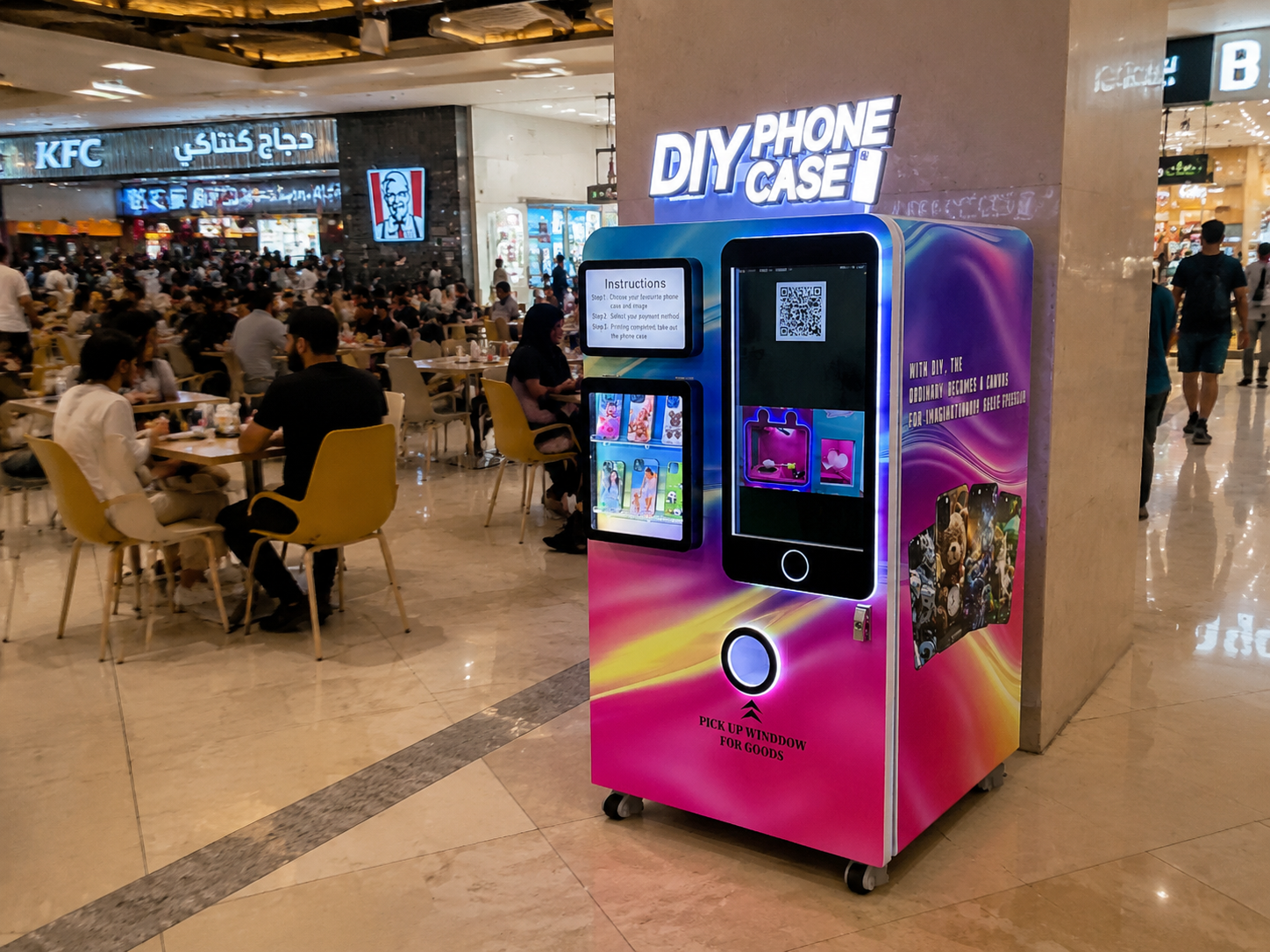

I talked to a guy in Dubai last month who put a phone case vending machine in a mall food court. Six weeks later, he’d made back his entire investment. Not a typo. Six weeks.
He’s not special. He just picked the right machine, put it in the right spot, and let it run.
Phone case printing vending machines are having a moment. Walk through any decent mall, airport, or university campus and you’ll spot them — those glossy kiosks where people tap a screen, upload a photo, and walk away with a custom phone case three minutes later. The numbers behind these machines are honestly hard to ignore: 95%+ profit margins, under $2 material cost per case, and selling prices that hit $20 to $40 a pop.
This guide lays out everything I’ve learned from talking with operators, studying the machine specs, and watching this market evolve. No fluff. Just what actually matters if you’re thinking about getting into this business.
How These Machines Actually Work (It’s Simpler Than You Think)
A phone case vending machine is basically a self-service kiosk with a printer inside. But the good ones — the ones that make money — are a lot smarter than that.
The Customer Experience
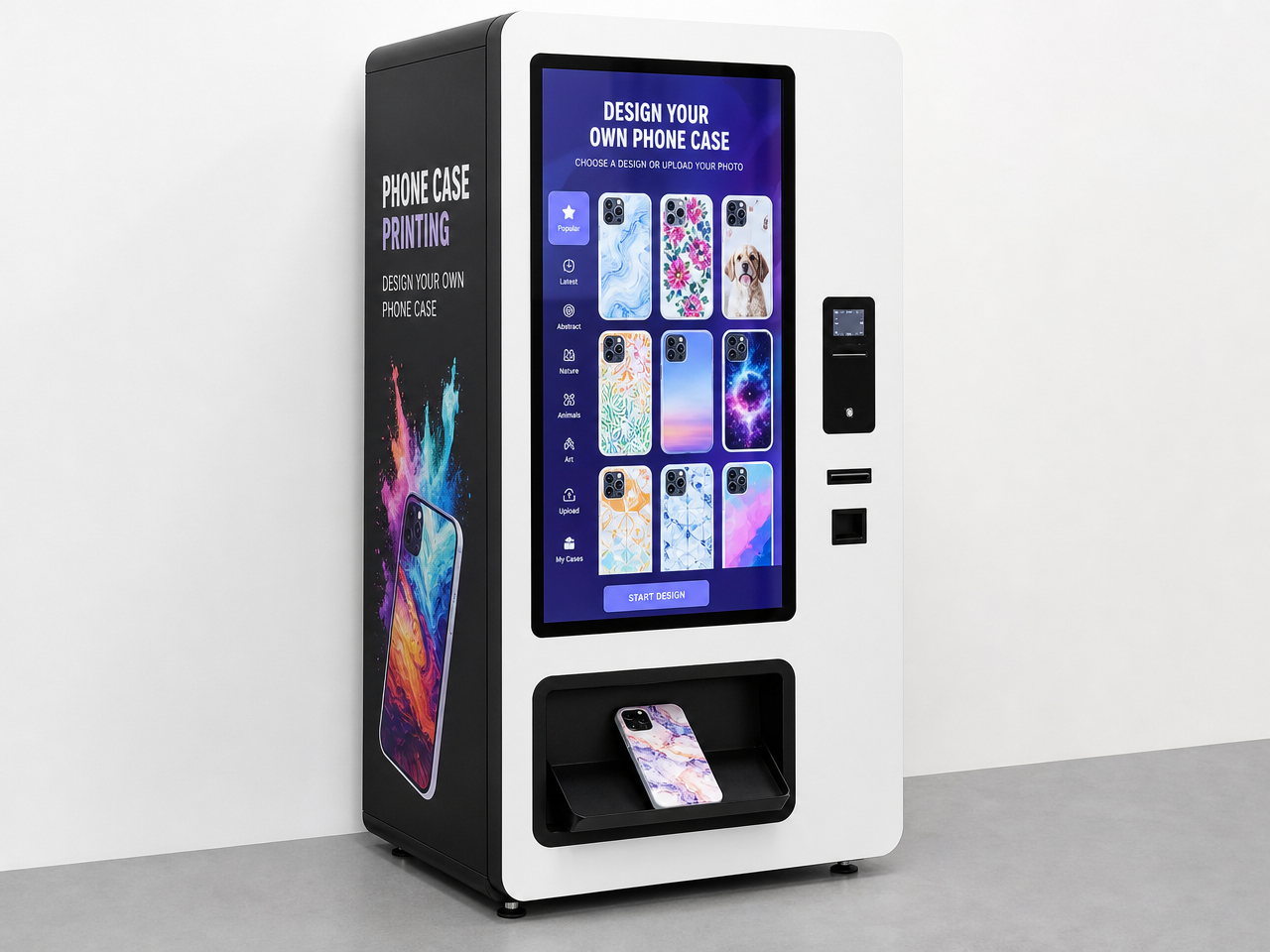
Someone walks up to the machine. They pick their phone model from the touchscreen (iPhone, Samsung, Huawei — the usual suspects). Then they either choose from a library of pre-loaded designs or upload their own photo. The machine takes payment — QR code, credit card, NFC, whatever works locally. About 90 seconds later, a freshly printed phone case drops into the collection tray.
The whole thing takes maybe two minutes start to finish.
What’s Under the Hood
The machine that’s generating the most buzz right now is the CT-SJK-360 from Red Rabbit. Here’s what makes it different from older models:
No-bracket printing technology. This is the big one. Traditional phone case printers need a plastic bracket inside each case to hold it steady during printing. That bracket adds cost, slows things down, and creates waste. The CT-SJK-360 prints directly onto blank cases without any internal frame. Faster, cheaper, cleaner.
The machine holds 448 blank cases across 56 different phone models. Four ink cartridges (C, M, Y, K) handle the printing. One set of ink prints roughly 2,000 cases before needing a refill. It runs on standard voltage and draws about 260W while printing — basically like running a desktop computer.
The Money Part: What Operators Are Actually Making
Let me give you the numbers that matter.
Unit Economics
| Item | Cost/Price |
|---|---|
| Blank phone case cost | $1–$2 |
| Ink cost per case | ~$0.15 |
| Electricity per case | ~$0.05 |
| Total cost per case | ~$1.20–$2.20 |
| Selling price | $20–$40 |
| Profit per case | $17.80–$38.80 |
That’s not a margin — that’s a multiplier.
Real Operator Numbers
I’ve collected data from operators running these machines in different settings:
🛍️ Shopping Mall — Dubai
Location: Food court, mall with ~15,000 daily visitors
Monthly sales: ~$10,500 · Cases: ~350/month at $30 avg
Monthly costs: ~$600 · Net profit: ~$9,900/month
🎓 University Campus — United States
Location: Student union building
Monthly sales: ~$6,800 · Cases: ~270/month at $25 avg
Monthly costs: ~$400 · Net profit: ~$6,400/month
🎡 Theme Park — Brazil
Location: Near gift shop exit
Monthly sales: ~R$38,000 (~$7,600 USD)
Monthly costs: ~R$2,500 · Net profit: ~R$35,500 (~$7,100 USD)
The theme park operator told me something interesting: his machine gets the most business right after the park’s main show ends. People are in a good mood, they’ve just had an experience, and they want something tangible to remember it by. A custom phone case with their vacation photo costs less than the t-shirt they just bought.
How Fast Does It Pay for Itself?
Most operators report ROI within 30–60 days. The machine costs $5,000 to $8,000 depending on customization. If you’re doing $9,000 in monthly profit, you’ve paid for the machine in your first month. If you’re in a slower location doing $4,000, it takes about two months. Either way, that’s an ROI timeline most businesses would kill for.
Where to Put These Machines (And Where Not To)
Location is everything. I can’t stress this enough. A great machine in a bad spot is a bad machine.
The Sweet Spots
Shopping malls. The obvious choice, and for good reason. Foot traffic is high, people are already in spending mode, and wait times between stores create natural browsing opportunities. Put the machine near food courts, cinema entrances, or kids’ zones.
Airports. Travelers with time to kill and money to spend. One operator in a European airport told me his machine does best during flight delays. “When people are bored and frustrated,” he said, “they’ll pay $30 for a distraction.”
University campuses. Students love personalization. They also love showing off their phones. A custom case is both — and students will pay for it.
Theme parks and tourist attractions. The souvenir angle here is powerful. People want something physical to remember an experience. A custom phone case with their photo at the park beats a generic keychain every time.
The Warning Signs
Don’t put these machines in: low-traffic retail stores (under 500 visitors/day — uphill battle), outdoor locations without shelter (sun, rain, dust destroy machines), or areas where the average age is over 50 (target demo is 16–35, older crowds don’t buy custom phone cases).
What Separates a Good Machine from a Money Pit
I’ve looked at a lot of these machines. Here’s what to check:
The printing technology. No-bracket printing is genuinely better. It’s not marketing fluff. Machines that require brackets have more moving parts, more things that break, and higher per-unit costs. Go with bracket-free if you can.
Cloud monitoring. Can you check sales, inventory, and machine status from your phone? If not, you’re going to spend way too much time physically visiting your machines. The good ones — like Red Rabbit’s system — let you track everything remotely and send low-stock alerts automatically.
Payment flexibility. Your machine needs to accept whatever payment method is dominant in your location. QR codes in China and Southeast Asia. Credit cards in North America. NFC growing everywhere. Get a machine that handles all of them.
Service and support. This is where cheap machines get expensive. When something breaks — and eventually something will — you need a manufacturer that responds fast. Check warranty, remote troubleshooting, and spare parts availability.
The Phone Case Vending Machine Market in 2026
The personalized accessories market isn’t slowing down. If anything, it’s accelerating.
Smartphone saturation. Nearly everyone has a phone. Nearly everyone wants to personalize it.
The instant gratification shift. Amazon taught people to expect two-day delivery. TikTok taught them to expect instant entertainment. A phone case vending machine gives them a custom product in two minutes. That’s a hard experience to beat.
Gen Z spending habits. Younger consumers value experiences and personalization over generic products. A custom phone case fits perfectly into this mindset. They’re not buying a case — they’re buying self-expression.
Getting Started: Your First 30 Days
If I were starting from zero today, here’s exactly what I’d do:
Week 1: Pick your machine. The CT-SJK-360 from Red Rabbit is a solid choice. Get the spec sheet, talk to the manufacturer, understand exactly what you’re buying. Visit the factory in Guangzhou if you can — they welcome visitors.
Week 2: Scout locations. Visit malls, airports, universities. Talk to property managers. Understand foot traffic patterns. Negotiate placement fees. Aim for rent under 15% of projected revenue.
Week 3: Order and set up. The machine takes 2–4 weeks for delivery. During that time, prepare your location — power, internet, signage. Stock up on blank cases for popular phone models in your area.
Week 4: Launch and monitor. Set initial pricing (start at $25 and adjust based on demand). Watch the sales data daily for the first month. Tweak your design library based on what sells.
The Bottom Line
Phone case printing vending machines are one of those rare businesses where the math actually works. Low cost, high margin, scalable, and almost entirely automated once set up.
The operators who do best aren’t the ones with the most experience. They’re the ones who pick good locations, keep their machines stocked, and let the numbers guide their decisions.
The market’s growing. The technology’s getting better. The window for early movers is still open — but it won’t be forever.
Ready to learn more?
Contact Red Rabbit for a personalized quote and business consultation →