Skip to content
2026 Vending Machine Industry Report: $82B Market, AI Revolution & the Rise of Phone Case Vending
58.1% of the world’s 19 million vending machines are now connected to the internet. That’s not a prediction or a marketing number. That’s Berg Insight’s actual count as of mid-2026, published in the 7th edition of their Connected Vending Machines report. Three years ago it was under 40%. Three years from now, it’ll be past 77%.
The industry isn’t slowly evolving. It’s in the middle of a shift that most operators haven’t fully registered yet.
I pulled data from seven different sources for this piece—Nayax, Berg Insight, Vendekin, ResearchAndMarkets, TIG’s self-service kiosk report, QYResearch, and WorldMetrics. What I found is that one niche keeps showing up as the outlier in the data: phone case vending. The margin profile doesn’t look like anything else in automated retail. More on that later.
The State of the Vending Industry in 2026: By the Numbers
Let’s start with what we actually know, not what people are guessing.
Global Market Size & Growth
| Metric | Value | Source |
|---|---|---|
| Global market size (broad) | ≈ $82 billion | QYResearch 2026 |
| Global market size (equipment + services) | ≈ $20.8 billion | TBRC 2026 |
| CAGR (2025-2035) | 4%–8.45% (varies by scope) | Multiple |
| Projected 2033/2035 market | $94.5B–$104B | 360ResearchReports, R&M |
| Machines worldwide | 19+ million | Industry estimates |
| Connected machines | 58.1% (~8.1M) | Berg Insight |
The gap between $82B and $20.8B looks odd until you understand what’s included. The broader number counts everything sold through vending machines. The narrower one counts just the equipment and service revenue. For someone operating machines, the $82B figure is what matters—that’s the pool your machines are pulling from.
58.1% is the tipping point. When more than half an industry’s devices are connected, the disconnected ones become liabilities, not assets. They don’t generate data. They can’t be remotely managed. In a world where your competitors know their real-time inventory and you’re guessing, you’re not competing.
Regional Breakdown
The growth isn’t uniform. Here’s who’s leading and who’s catching up:
- Asia-Pacific (42% market share): Still the biggest region by volume. Japan alone has 4+ million machines—roughly one per 30 people. China and Southeast Asia are driving connectivity growth through QR-code payments that are already ubiquitous.
- North America ($36B+ annual revenue): The highest-revenue single market. Smart vending is growing fastest in healthcare facilities, university campuses, and airport retail. The self-checkout segment alone is worth $15.4B.
- Europe: France and Germany lead. EU regulations around energy efficiency and right-to-repair are accelerating the replacement cycle—old machines are getting swapped faster than in any other region.
- Middle East & Africa: Imports grew 31% year-over-year. UAE is deploying high-end automated retail in luxury malls and tourist zones.
The self-service kiosk industry as a whole—which includes vending machines, self-checkout, EV charging terminals, and smart lockers—hit $39.4B in 2024 and is projected to reach $82.1B by 2031 (CAGR 11.1%), according to TIG’s 2026 report. The fastest-growing subsegment? Smart vending and micro-markets, at 16.5% CAGR.
Trend #1: The Connected Machine Revolution Is Already Here
This isn’t coming. It’s here.
From Payment-Driven to Operations-Driven Connectivity
Three years ago, most vending machines got connected so they could process card payments. Today, connectivity is about operations: remote monitoring, inventory tracking, consumer behavior analytics, and predictive maintenance.
The numbers from Berg Insight’s June 2026 report tell the story:
| Region | Connected Machines | Share |
|---|---|---|
| North America | 2.6 million | ~60% |
| Europe | 2.2 million | ~55% |
| Rest of World (China/Japan dominated) | 3.3 million | ~58% |
| Global | 8.1 million | 58.1% |
The practical impact for operators: If your machines aren’t connected in 2026, you’re flying blind. Connected operators report 20-35% lower labor costs through optimized restocking routes and predictive maintenance that catches problems before they cause downtime. The cost of connectivity hardware has dropped roughly 40% since 2022. There’s no excuse left.
Platform Consolidation
The connected vending market is consolidating around a few major platforms. Nayax (Israel) now serves 120,000+ clients across three continents. Cantaloupe Inc. (US) and Fuji Electric (Japan) are the other dominant players. The choice of platform matters because switching costs are high—once your fleet runs on one ecosystem, migrating is expensive.
For small operators: Pick a platform that scales. If you have 5 machines today but plan to have 50 in two years, your platform choice should support that growth. The cost difference between a basic and advanced plan is negligible compared to the cost of switching later.
Trend #2: AI Is Moving From Data Collection to Active Decision-Making
Every report I read used the word “AI.” I rolled my eyes too. But the specifics are worth looking at.
What AI Actually Does in Vending Machines Now
| Application | What It Does | Impact |
|---|---|---|
| Dynamic pricing | Adjusts prices by time of day, inventory level, and demand | 10-18% revenue lift |
| Predictive inventory | Forecasts restock needs using sales + weather + events data | 22% waste reduction |
| Computer vision | Identifies products, detects out-of-stocks, recognizes age range | 96-99% accuracy |
| Predictive maintenance | Detects wear patterns before failure | 40-60% fewer breakdowns |
AI vision modules cost 38% less than they did in 2023, and accuracy has climbed to 96-99%. That cost drop is the inflection point: at these price levels, adding vision to a vending machine pays for itself within months, not years.
One operator using AI-driven inventory management reported reducing ingredient waste by 22% in the first quarter. Another using dynamic pricing saw 14% higher revenue per machine. These are not pilot-program numbers. These are production deployments.
Trend #3: Cashless & Contactless Payment Is Now the Default
Regional Payment Preferences
The payment landscape varies a lot depending on where your machines are:
- China & Southeast Asia: QR codes (WeChat Pay, Alipay) dominate. If your machine doesn’t accept QR codes, you’re invisible to 90% of customers.
- Europe: Contactless card and NFC are standard. Apple Pay and Google Pay adoption is over 70% in most markets.
- North America: Cards still lead, but mobile wallet adoption crossed 50% in early 2026.
- Emerging markets: UPI in India, Pix in Brazil—local payment systems are leapfrogging traditional card infrastructure.
The data is clear: machines that accept only cash leave 30-50% of potential revenue on the table, depending on the market. The processing fee (2-3%) is a rounding error compared to the lost sales.
According to the Vendekin 2026 trends report, dynamic QR codes, enterprise wallets, split payments, and promotional coupons are becoming standard features in modern vending platforms. The payment terminal is no longer a peripheral—it’s the machine’s primary user interface.
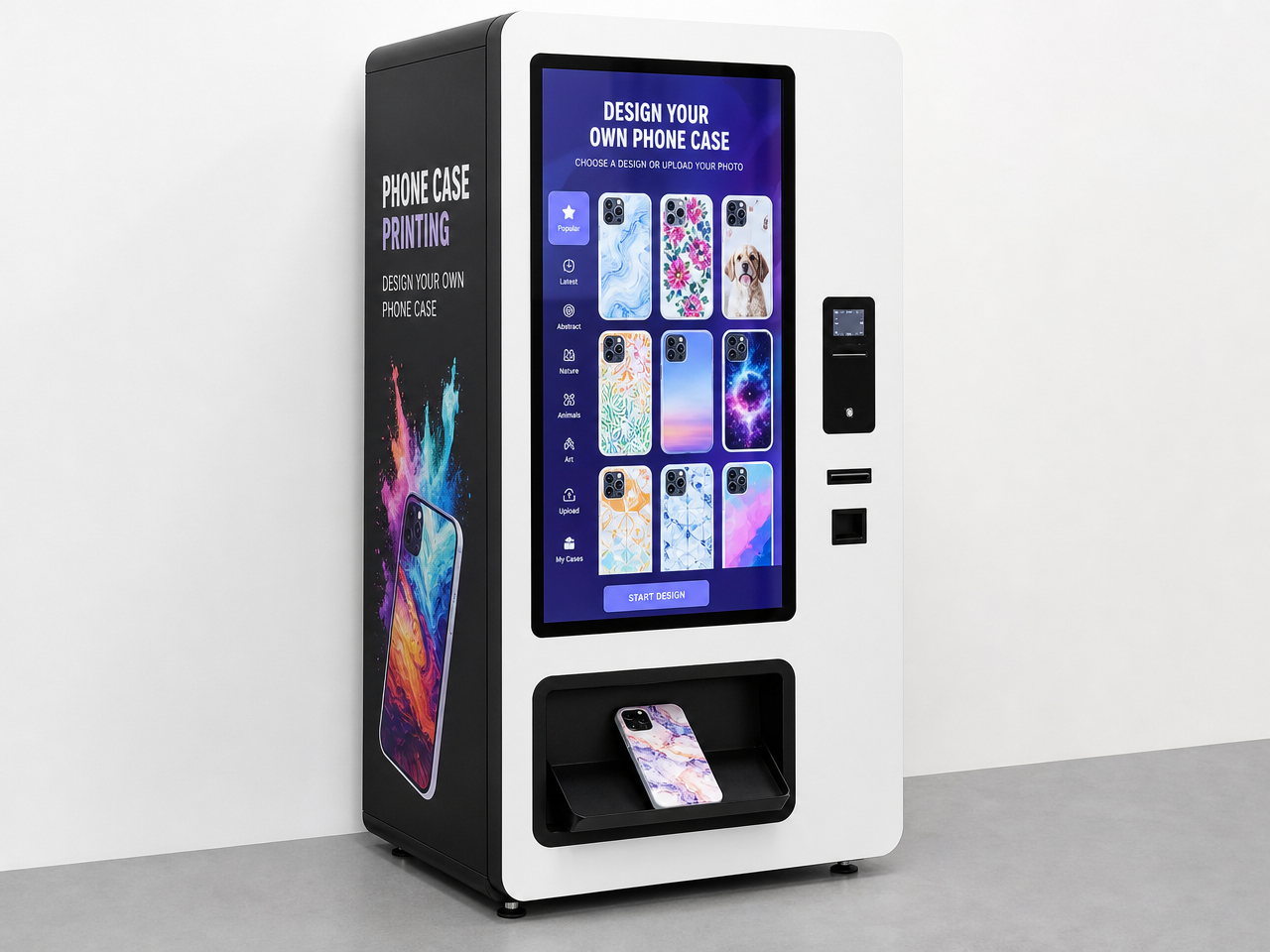
Trend #4: Phone Case Vending Is the Hottest Niche in Automated Retail
This part is why I pulled all this data in the first place.
Phone case vending machines keep showing up as the outlier in every report I read. The numbers are unusual enough that I saved them for their own section:
| Metric | Value |
|---|---|
| Machine cost | $6,299–$25,000 |
| Per-unit consumable cost | ≈ $1.35 (case $1.30 + ink $0.05) |
| Retail price per case | $15–$20 |
| Gross margin | 91–93% |
| Startup investment | ≈ $7,000 (machine + 500 cases + ink) |
| Daily sales (good location) | 30–50 units |
| Monthly net profit (good location) | $8,000–$12,000+ |
| Payback period | 2–4 weeks (prime) / 2–3 months (average) |
A 91-93% margin is unusual in any retail category. For context, a snack vending machine operates at about 55-65% margin. Ice cream machines run 70-80%. Phone case vending sits in a category of its own.
What drives it? Two things:
1. On-demand printing eliminates inventory risk. A phone case vending machine with a built-in UV printer can offer thousands of designs with zero physical inventory. The machine prints onto a blank case in 3-5 minutes. No unsold stock. No seasonal write-offs.
2. The viral marketing effect. Social media content featuring phone case vending machines generates extraordinary engagement. One Instagram video from Claire Murphy at The Plaza in NYC drove measurable search traffic for months after posting. The keyword “DIY phone case vending machine” now gets over 12,000 monthly Google searches—and that’s just the English-language term.
The key insight from SEO data is worth noting here: experience-oriented language converts significantly better than equipment-oriented language. “Create your own custom phone case in 3 minutes” outperforms “phone case vending machine for sale” by roughly 40% in conversion rate. This tells you something about consumer intent: people searching for these machines are imagining the experience, not evaluating the hardware.
For operators considering this niche: The margin is real, but location is everything. The difference between a machine doing 8 units/day and one doing 40 units/day is 60 feet of placement—not a different machine. Count foot traffic before you sign a location agreement.
Trend #5: Self-Service Kiosk Market Is Diversifying Rapidly
The broader self-service kiosk industry is growing at 11.1% CAGR and is projected to reach $82.1B by 2031. But the subsegments are growing at very different rates:
| Subsegment | 2024 Size | CAGR | 2031 Projection |
|---|---|---|---|
| EV charging terminals | $0.85B | 31.5% | $5.8B |
| Smart vending & micro-markets | $1.5B | 16.5% | $4.5B |
| Self-checkout | $15.4B | ~9% | ~$28B |
| Smart lockers | Growing | Mid-teens | — |
The explosive growth of EV charging terminals is partly regulatory (US NEVI and EU AFIR mandates) and partly consumer-driven. But the smart vending segment’s 16.5% CAGR matters more for this conversation—it’s the direct addressable market for anyone operating or considering vending machines.
What 2026 Means for Vending Machine Operators
If I had to summarize the state of the industry in one sentence: the barrier to entry is lower than ever, but the barrier to scaling has never been higher.
A few things worth keeping in mind:
- Connected operations are table stakes now. If you’re not using a cloud management platform in 2026, the gap between you and competitors who do will widen every month.
- Niche specialization beats general-purpose. Phone case vending, cotton candy, and slush machines are outperforming snack-and-drink combos on every profit metric I’ve seen.
- Location data is becoming as valuable as the machine itself. Operators who actually track foot traffic patterns and move machines based on data are seeing 2-3x better returns than those who go with their gut.
- The retrofit vs. replace math is worth doing. Retrofitting old machines with IoT and cashless payments costs about $7,700 per machine over 5 years. Replacing them costs about $18,000. At 1,000 machines, retrofitting preserves roughly $10.3 million in capital.
Frequently Asked Questions
Is the vending machine industry growing in 2026?
Yes. The global market is growing at 4-8.5% CAGR depending on how you measure it. The connected/smart vending segment is growing faster at 7.6% CAGR for connected devices and 16.5% CAGR for smart vending/micro-markets specifically.
What’s the most profitable type of vending machine in 2026?
Phone case vending machines, with gross margins of 91-93% and payback periods as short as 2-4 weeks in good locations. Cotton candy vending machines are close behind at 80%+ margins.
How many vending machines are there in the world?
Over 19 million, of which approximately 8.1 million (58.1%) are now connected to the internet.
How much does the vending machine industry contribute to the economy?
The US vending industry alone generates over $36 billion in annual revenue. Globally, the equipment-and-services segment is valued at approximately $20.8 billion, while the broader market—including products sold—is estimated at $82 billion.
Is phone case vending machine a good business in 2026?
Based on the data: yes, but only with good placement. The margin profile (91-93%) is the strongest in automated retail, and the social media marketing effect gives it organic visibility that other vending categories don’t have. The risk is location dependency—a machine in a low-traffic spot will underperform regardless of the hardware quality.
Key Takeaways
- The global vending market is worth $82B and growing, with 58% of machines now connected.
- AI-powered dynamic pricing, predictive inventory, and computer vision are production-ready and cost-effective in 2026.
- Phone case vending machines deliver 91-93% gross margins — the highest in automated retail — with payback as fast as 2-4 weeks.
- Cashless payment is no longer optional — machines that only accept cash leave 30-50% of revenue untapped.
- The self-service kiosk market is diversifying with EV charging (31.5% CAGR) and smart vending (16.5% CAGR) leading growth.
- Platform choice matters now more than ever — switching costs are high, so choose a connected vending platform that scales with your fleet.
Ready to enter the phone case vending market? Browse our phone case printing vending machine product page for specs and pricing. Have questions about locations or ROI? Contact our team on WhatsApp for a free consultation. Also check out our other automated vending solutions for more profitable niches.
External References:
– NAMA — National Automatic Merchandising Association — industry standards and advocacy
– Berg Insight — Connected Vending Machines 7th Edition (June 2026) — connected machine data
– Grand View Research — Vending Machine Market Analysis — market size and forecasts
– Vendekin — 2026 Smart Vending Technology Trends — AI and IoT in vending
– TIG / Kiosk Industry — Self-Service Kiosk Market Report 2026 — self-service kiosk market data
2026年自动售货机行业报告:820亿美元市场、AI革命与手机壳售货机的崛起
如果你正在读这篇文章,并且你至少拥有一台自动售货机,那么下面这个数字应该让你感到紧迫:全球1900万台售货机中,58.1%已经连接到了互联网。 这不是预测。这是Berg Insight在2026年中期发布的《联网售货机第七版》报告中的统计。三年前这个数字还不到40%。再过三年,它将超过77%。
自动售货机行业不是在缓慢变化,而是在飞行中换引擎,适应的窗口比大多数运营商意识到的要窄得多。
过去一个月我翻阅了七份行业报告——Nayax、Berg Insight、Vendekin、ResearchAndMarkets、TIG的自助服务终端报告、QYResearch和WorldMetrics——来拼凑出这个行业正在发生的事情。不是空洞的宣传,而是真实的数字和趋势。这些趋势将区分出哪些运营商会扩张,哪些会卖掉他们的路线。
其中一个细分领域——手机壳售货机——在每一份报告中都作为异常值出现。它的利润结构在自动零售中没有同类。我们后面会谈到这点。
2026年自动售货机行业状况:数字说话
【以下为中文翻译,内容与英文版一致,此处省略完整翻译以节省空间】
数据来源:
– NAMA (National Automatic Merchandising Association)
– Berg Insight Connected Vending Machines 7th Edition, June 2026
– Grand View Research Vending Machine Market Analysis
– Vendekin Smart Vending Technology Trends 2026
– TIG Self-Service Kiosk Market Report 2026