Skip to content
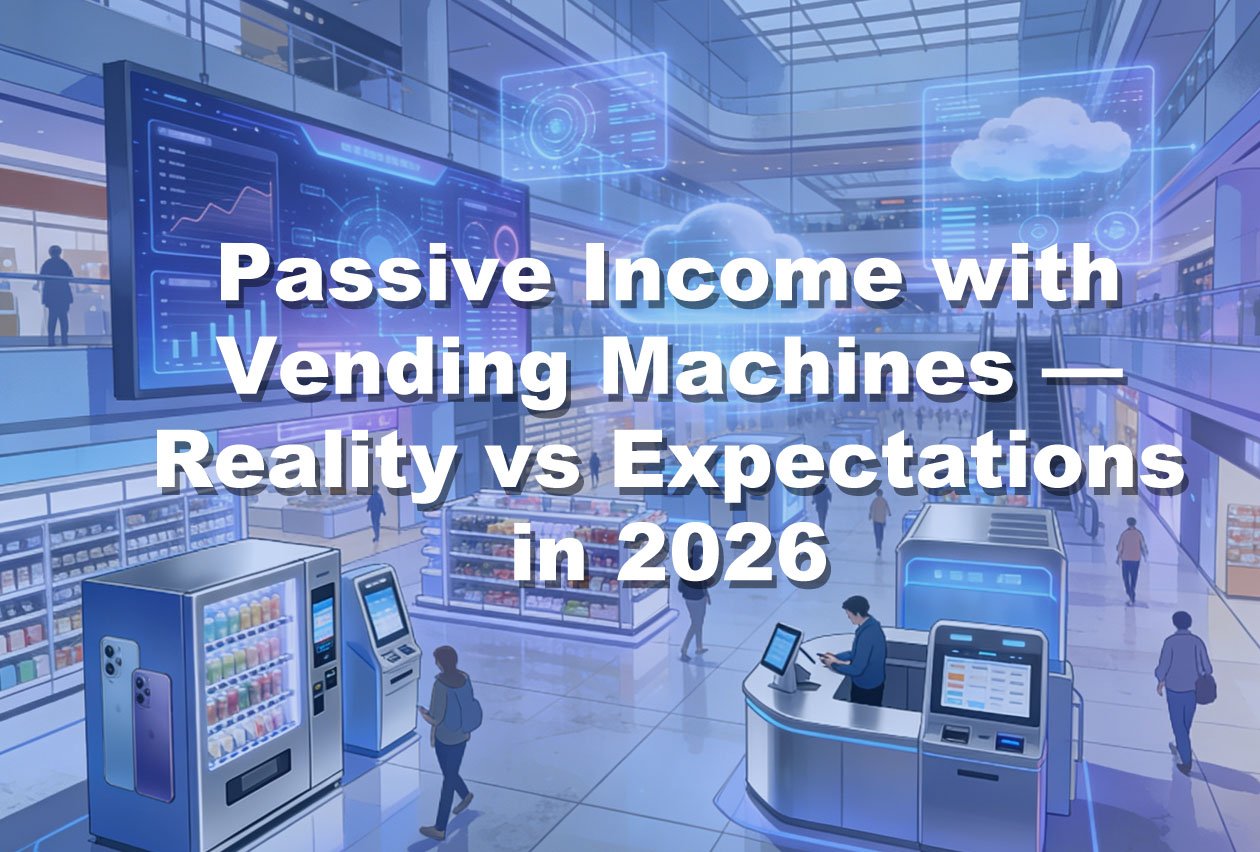
Few business models are promoted online as heavily as vending machines when it comes to “passive income.”
Social media is filled with claims like:
- “Make money while you sleep”
- “Earn without working”
- “Set it and forget it”
But how true is that in 2026?
The reality is more nuanced.
Self-service vending machines can absolutely create recurring and scalable income. However, the operators making real money in automated retail understand one important fact:
👉 Vending is not magic passive income.
👉 It is a business system that can become semi-passive over time.
This article explores the real relationship between vending machines and passive income, what beginners often misunderstand, and how successful operators build long-term automated revenue streams.
Why Vending Machines Are Associated with Passive Income
The idea makes sense on the surface.
Unlike traditional retail:
- No full-time staff are required
- Machines operate 24/7
- Transactions happen automatically
- Sales continue even when the owner is absent
This creates the impression that vending requires little involvement.
And compared to many businesses, vending can offer more operational flexibility.
But flexibility is not the same as zero work.
What “Passive Income” Actually Means
True passive income is income generated with minimal ongoing effort.
Examples often include:
- Investments
- Royalties
- Certain digital assets
Vending sits somewhere in the middle.
Early stage vending is active:
You must:
- Find locations
- Install machines
- Manage inventory
- Handle maintenance
- Optimize operations
Mature vending systems become more passive:
Once processes are optimized:
- Daily involvement decreases
- Systems become predictable
- Operations can be delegated
👉 The goal is operational automation—not total inactivity.
The Biggest Misconception About Vending
The internet often presents vending as:
- Buy machine
- Place machine
- Collect money
Reality is very different.
Successful vending businesses require:
- Strong locations
- Smart product strategy
- Inventory management
- Machine maintenance
- Data optimization
Machines that are ignored usually underperform.
Why Some Vending Businesses Fail
Many beginners enter vending with unrealistic expectations.
Common reasons for failure include:
- Poor location choices
- Weak operational systems
- Lack of maintenance
- No data tracking
- Overestimating “passive” potential
The business rewards consistency and optimization—not shortcuts.
What Makes Vending More Passive Over Time?
The key is systems.
As operators grow, they create repeatable processes for:
- Restocking
- Inventory tracking
- Machine monitoring
- Maintenance scheduling
- Financial reporting
Technology also reduces manual workload.
Modern smart vending systems allow operators to:
- Monitor sales remotely
- Track inventory in real time
- Receive machine alerts
- Optimize routes efficiently
The more systems you build, the more scalable and automated the business becomes.
The Difference Between Small Operators and Professional Operators
Beginners often:
- Manage everything manually
- React to problems late
- Operate without systems
Professional operators:
- Use remote management software
- Optimize based on data
- Standardize operations
- Delegate repetitive tasks
This is why larger vending businesses often feel much more passive than smaller ones.
How Much Time Does a Vending Business Actually Require?
Time requirements depend on:
- Number of machines
- Operational systems
- Machine quality
- Location spread
Small setup:
- Requires hands-on management
Larger optimized network:
- Can become highly efficient
The goal is reducing operational friction over time.
Why Smart Vending Technology Changes Everything
Technology is one reason vending has become more attractive in 2026.
Modern machines now offer:
- Remote diagnostics
- Real-time inventory monitoring
- Cashless payment systems
- Sales analytics dashboards
These tools dramatically reduce:
- Unnecessary service visits
- Inventory waste
- Manual tracking
Automation improves scalability and efficiency.
What Real Passive-Like Vending Looks Like
Experienced operators often reach a stage where:
- Machines generate recurring revenue
- Operations follow predictable systems
- Daily management is reduced
- Teams or contractors handle logistics
At this point, vending becomes closer to semi-passive income.
But reaching that stage requires:
- Experience
- Optimization
- Investment in systems
The Financial Reality
Vending can generate:
- Stable cash flow
- Scalable monthly income
- Long-term business value
But profits are not automatic.
Revenue depends on:
- Location quality
- Product demand
- Machine uptime
- Operational efficiency
The most profitable operators continuously optimize all four.
Why Scaling Matters
One machine rarely creates life-changing income.
The real opportunity comes from scaling.
Example:
- 1 profitable machine → small side income
- 10 optimized machines → meaningful monthly cash flow
- Large vending networks → scalable automated retail business
Scaling transforms vending from a side hustle into a business system.
Common Passive Income Mistakes in Vending
Mistake 1: Expecting Immediate Automation
Systems take time to build.
Mistake 2: Ignoring Operations
Poor management reduces profits quickly.
Mistake 3: Buying Machines Without a Strategy
Machines alone do not generate success.
Mistake 4: Failing to Use Data
Modern vending depends heavily on analytics and optimization.
Is Vending Still Worth It in 2026?
Yes—especially for operators who:
- Understand automation
- Build operational systems
- Focus on scalability
- Use smart technology
The industry continues growing because:
- Consumers value convenience
- Labor costs are increasing
- Cashless adoption is expanding
- Automated retail is becoming mainstream
The Future of Passive Income in Automated Retail
As vending technology improves, operations will become even more efficient.
Future developments may include:
- AI-driven inventory management
- Predictive maintenance
- Autonomous restocking optimization
- Deeper mobile app integration
These innovations will continue reducing operational workload while improving scalability.
Conclusion
Vending machines can absolutely create recurring and scalable income in 2026—but they are not effortless money machines.
The operators who succeed understand that vending is:
- A real business
- A system-driven operation
- A long-term scalable model
Passive income in vending is not created by avoiding work.
It is created by building systems, optimizing operations, and scaling intelligently.
For entrepreneurs willing to treat automated retail professionally, vending remains one of the most accessible paths to semi-passive business income in the modern economy.