Skip to content
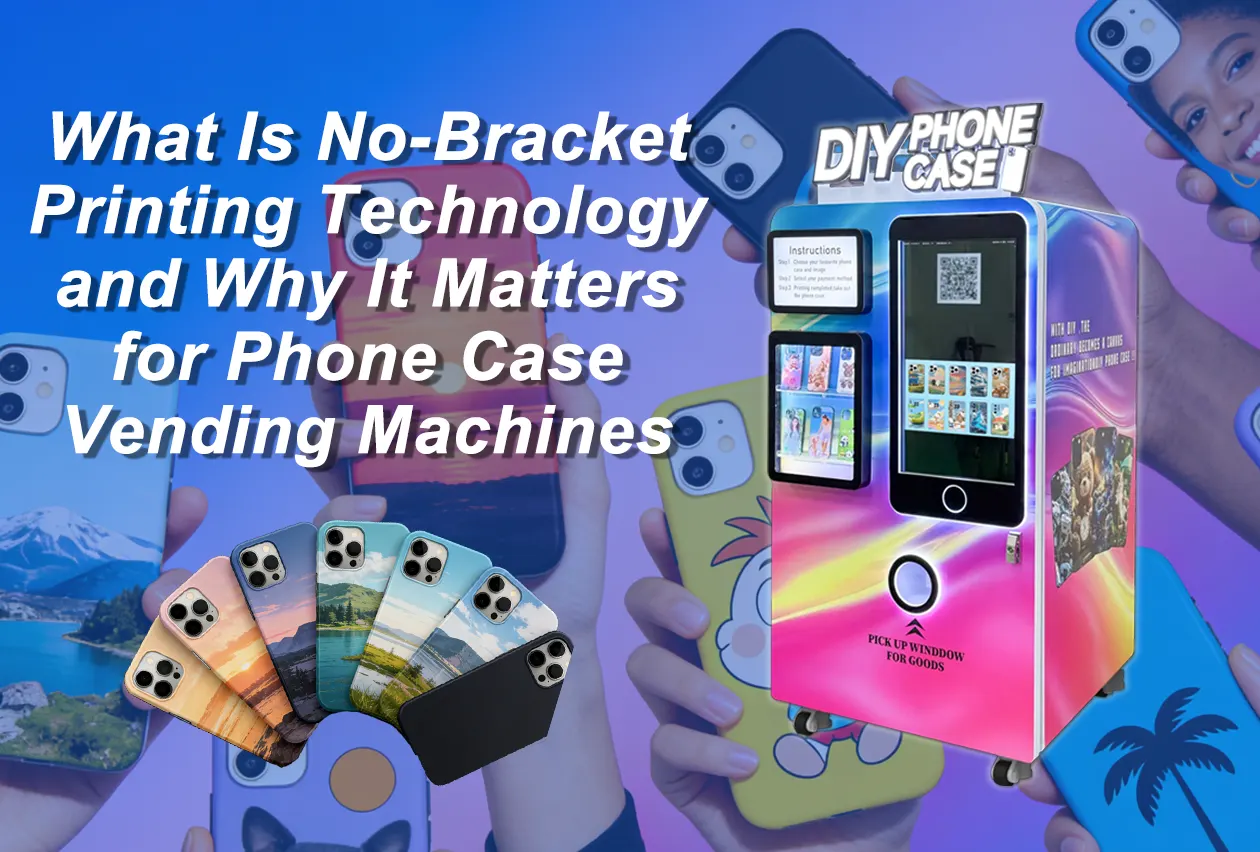
When most people first look at a phone case vending machine, they focus on the outside:
The screen, the design interface, the finished product.
But experienced operators look deeper.
They ask one critical question:
What printing technology is inside the machine?
Because in this business, the printing system doesn’t just affect quality —
it directly determines cost, stability, speed, and long-term profit.
One of the most important advancements in recent years is No-Bracket Printing Technology.
If you’re considering investing in a phone case vending machine, understanding this technology can save you thousands of dollars—and countless operational headaches.
1. What Is No-Bracket Printing Technology?
Let’s start with the basics.
Traditional phone case printing machines use physical brackets (or molds) to hold each phone case in place during printing.
That means:
- Different phone models require different brackets
- Brackets need to be installed, replaced, and maintained
- Alignment depends partly on mechanical precision
No-Bracket Printing Technology removes this requirement completely.
Instead, the system uses:
- Smart positioning systems
- Sensor-based alignment
- Software-controlled printing paths
The result is simple:
👉 The machine can print directly onto the phone case without any physical bracket.
2. Why Traditional Bracket Systems Create Problems
At first glance, brackets may seem like a small detail.
In reality, they introduce multiple layers of inefficiency.
1. Increased Consumable Costs
Each phone model requires a matching bracket.
Over time, you need to:
- Purchase new brackets
- Replace worn-out ones
- Store multiple types
This adds hidden costs that many beginners overlook.
2. Higher Maintenance Complexity
More physical components mean:
- More points of failure
- More alignment issues
- More time spent on troubleshooting
A slightly misaligned bracket can lead to:
- Printing errors
- Wasted materials
- Customer dissatisfaction
3. Slower Adaptation to New Phone Models
New phone models are released every year.
With bracket systems, this means:
- Waiting for new bracket production
- Manual replacement
- Possible downtime
This delay can cost you early sales opportunities.
3. How No-Bracket Printing Solves These Problems
No-Bracket Printing simplifies the entire workflow.
1. No Extra Hardware Required
- No brackets to buy
- No accessories to manage
- No physical swapping
This reduces both cost and operational friction.
2. Faster Printing Workflow
Without bracket installation:
- The process is fully automated
- Less mechanical adjustment
- Shorter production time
Faster printing leads to:
- Better customer experience
- Higher daily transaction capacity
3. Higher Stability and Reliability
Fewer moving parts = fewer failures.
No-Bracket systems are designed for:
- Continuous operation
- Consistent alignment
- Lower error rates
For unattended vending machines, reliability is everything.
4. Impact on Profit: Small Details, Big Difference
At first glance, saving a few cents per case may not seem significant.
But let’s look at the bigger picture.
Example:
- 20 sales per day
- 600 sales per month
- 7,200 sales per year
If No-Bracket Printing saves just $0.20 per case:
👉 Annual savings per machine: $1,440
Now multiply that across multiple machines, and the impact becomes substantial.
And that’s just cost savings—before considering:
- Reduced downtime
- Fewer failed prints
- Higher customer satisfaction
5. Better Customer Experience = Higher Conversion
Customers don’t understand printing technology—but they feel the difference.
No-Bracket systems typically deliver:
- More precise image placement
- Cleaner edges
- Faster completion time
These improvements lead to:
- Higher trust
- Better reviews
- More repeat usage
In vending, experience directly influences conversion rate and pricing power.
6. Easier Expansion for New Phone Models
Phone trends change fast.
A good vending machine should adapt just as quickly.
With No-Bracket Printing:
- New phone models are added via software updates
- No hardware replacement needed
- No downtime for reconfiguration
This allows operators to:
- Capture demand immediately
- Stay competitive
- Reduce operational interruptions
7. Why This Technology Is Essential for Vending Machines
Not all printing systems are suitable for vending.
A vending machine must be:
- Automated
- Error-resistant
- Easy to maintain
- Stable under continuous use
No-Bracket Printing fits perfectly because it:
- Minimizes manual intervention
- Reduces mechanical complexity
- Ensures consistent output
This is why most modern commercial-grade phone case vending machines are moving toward this system.
8. How to Identify If a Machine Uses Real No-Bracket Technology
Not all suppliers define “No-Bracket” the same way.
Before buying, ask:
- Does the machine require any physical holder or mold?
- How is alignment achieved? (sensor vs manual positioning)
- Can new phone models be added without hardware changes?
- What is the average printing time per case?
- What happens if alignment fails?
A true No-Bracket system should:
- Require minimal manual adjustment
- Support multiple models seamlessly
- Maintain consistent print quality
9. Common Misconceptions
“No bracket means less precision”
In reality, modern systems use software-controlled alignment, which is often more precise than mechanical fixtures.
“It’s more complicated”
For operators, it’s actually simpler:
- Fewer parts
- Less maintenance
- Easier operation
“It’s only for high-end users”
Most systems are designed for plug-and-play use, making them suitable even for beginners.
Conclusion: Technology That Defines Your Profit Ceiling
In the phone case vending machine business, not all machines are equal.
Two machines may look similar on the outside—but inside, the difference in technology can determine:
- Your operating cost
- Your maintenance workload
- Your pricing flexibility
- Your long-term profitability
No-Bracket Printing Technology is not just a feature.
It’s a foundation for scalable, stable, and high-margin operation.
If you’re serious about building a sustainable vending business, this is one detail you cannot afford to ignore.