Skip to content
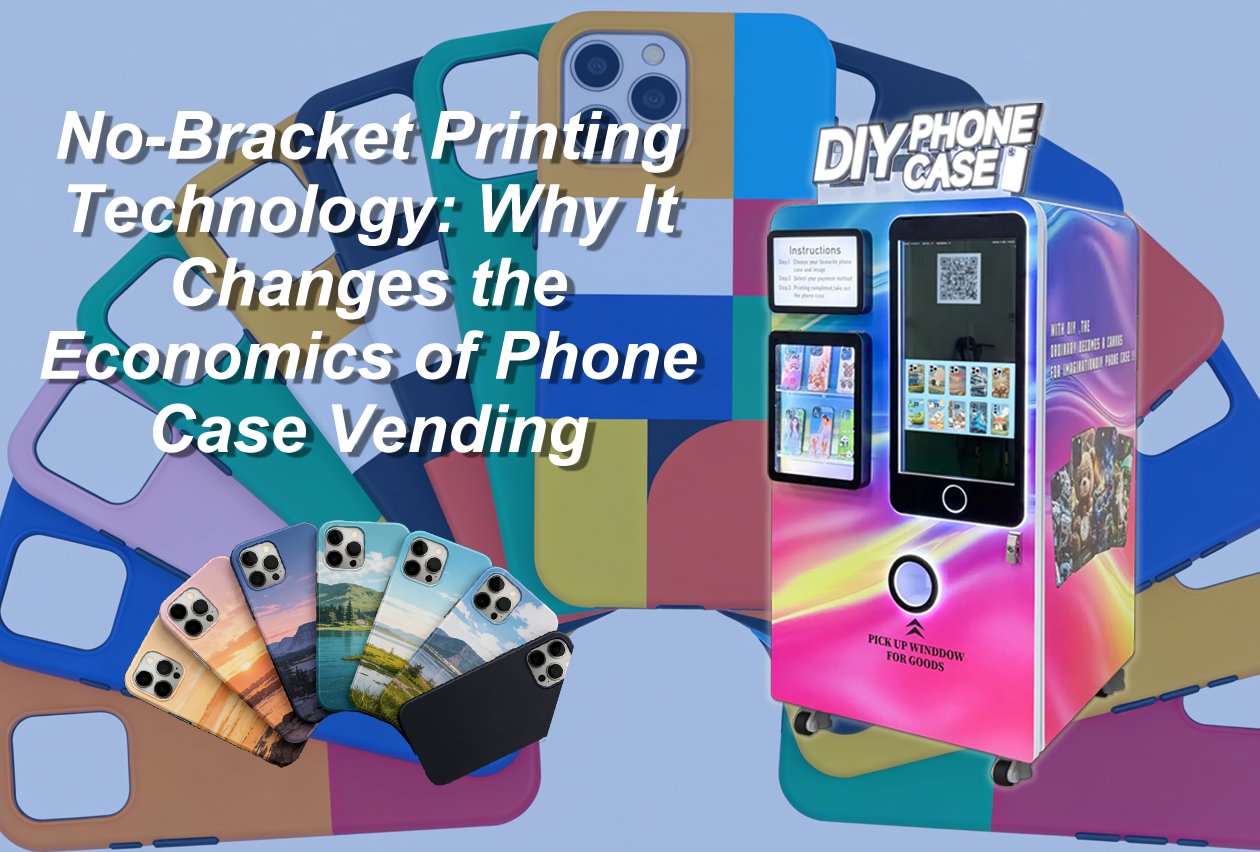
When investors evaluate a phone case vending machine, they often focus on:
- Location
- Selling price
- Daily sales volume
But experienced operators look at something deeper:
Printing structure.
One of the most important breakthroughs in recent years is no-bracket printing technology — a structural improvement that dramatically changes operating cost, maintenance risk, and long-term profitability.
Most beginners underestimate this factor.
Professionals never do.
Today, we’ll break down why this technology matters — not from a marketing perspective, but from a real business standpoint.
1. What Is “Bracket” Printing in Traditional Machines?
In many early-generation phone case vending machines, printing required:
- A fixed frame
- A holding bracket
- A mechanical clamping system
The phone case had to be locked into a rigid holder before printing.
On paper, this sounds stable.
In practice, it creates multiple hidden problems:
- Extra moving parts
- Higher mechanical wear
- Alignment failures
- Increased maintenance frequency
Each additional mechanical structure increases friction, calibration time, and long-term repair cost.
And when a machine is deployed in a mall or airport, downtime equals lost revenue.
2. What Is No-Bracket Printing?
No-bracket printing eliminates the traditional clamping structure.
Instead of mechanical fixation, the system relies on:
- Precision positioning technology
- Smart optical calibration
- Adaptive height sensing
- Stable vacuum or magnetic positioning (depending on design)
The result?
Fewer moving components.
Simpler internal structure.
Higher reliability.
And in vending business, reliability equals profit.
3. Why Fewer Moving Parts Means Higher ROI
Every mechanical part is a potential failure point.
Traditional bracket systems can cause:
- Print misalignment
- Scratched cases
- Mechanical jams
- Longer repair cycles
If a vending machine is down for even 24 hours in a high-traffic mall, the revenue loss is immediate.
No-bracket systems significantly reduce:
- Mechanical friction
- Calibration errors
- Maintenance frequency
Over 12–24 months, the savings in servicing and downtime can exceed the initial machine price difference.
That’s not a feature.
That’s an economic advantage.
4. Print Speed and Customer Experience
Customer patience inside a vending environment is limited.
Most buyers expect:
- Simple operation
- Fast production
- Immediate gratification
Bracket-based systems often require:
- Mechanical positioning
- Stabilization delay
- Manual calibration cycles
No-bracket technology reduces process complexity, which can shorten:
- Setup time
- Adjustment cycles
- Total print duration
Even saving 20–40 seconds per order can increase daily transaction capacity in busy locations.
And when machines operate in airports or tourist areas, speed matters.
5. Reduced Risk of Physical Damage
Phone cases vary in:
- Thickness
- Material
- Surface texture
- Structural rigidity
Traditional clamping can:
- Bend softer cases
- Leave pressure marks
- Cause slight misprints
No-bracket systems are designed to accommodate variation without mechanical pressure.
That means:
- Fewer damaged products
- Lower waste rate
- Higher customer satisfaction
In premium pricing environments ($20–$40 per case), product quality directly affects reputation.
6. Maintenance Cost Comparison Over 2 Years
Let’s look at the economics.
Bracket-based systems may require:
- Regular alignment adjustments
- Bracket replacement
- Motor maintenance
- Increased technician visits
No-bracket systems typically require:
- Routine cleaning
- Basic calibration checks
- Standard ink system maintenance
Less structural wear means:
- Lower annual service budget
- Fewer emergency repairs
- More predictable operating cost
For investors running multiple machines, cost predictability is critical.
7. Better Scalability for Multi-Location Deployment
When operators expand from:
- 1 machine
to - 5 machines
to - 20 machines
Maintenance complexity multiplies.
Machines with simpler mechanical structures scale better because:
- Staff training is easier
- Troubleshooting is faster
- Spare parts inventory is lower
No-bracket printing technology reduces operational complexity, which becomes increasingly important as network size grows.
This is not just about engineering.
It’s about system scalability.
8. Long-Term Brand Positioning
Premium vending businesses rely on perception.
Customers buying a customized phone case at a shopping mall expect:
- Smooth printing
- Perfect alignment
- Professional finish
If machines frequently jam or misprint, brand trust erodes quickly.
No-bracket systems improve:
- Print consistency
- Structural stability
- Operational smoothness
And consistency builds trust.
Trust supports higher pricing.
Higher pricing improves margins.
Margins determine sustainability.
9. Why Serious Investors Ask About Printing Structure First
Experienced buyers don’t ask:
“How many designs does it offer?”
They ask:
“What is the internal printing mechanism?”
Because they understand:
Hardware design determines lifetime cost.
Two machines may look identical externally.
Internally, their engineering philosophy can be completely different.
And that difference determines whether the business becomes:
- A stable income asset
or - A maintenance headache
Conclusion: Structural Simplicity Is Strategic Power
In the vending machine industry, complexity is expensi ve.
No-bracket printing technology:
- Reduces mechanical failure
- Lowers maintenance cost
- Improves print speed
- Enhances customer experience
- Increases long-term ROI
It is not a marketing buzzword.
It is a structural upgrade that changes the economics of phone case vending machines.
When evaluating equipment, don’t just compare price.
Compare engineering philosophy.
Because in automated retail, simplicity wins.