Skip to content
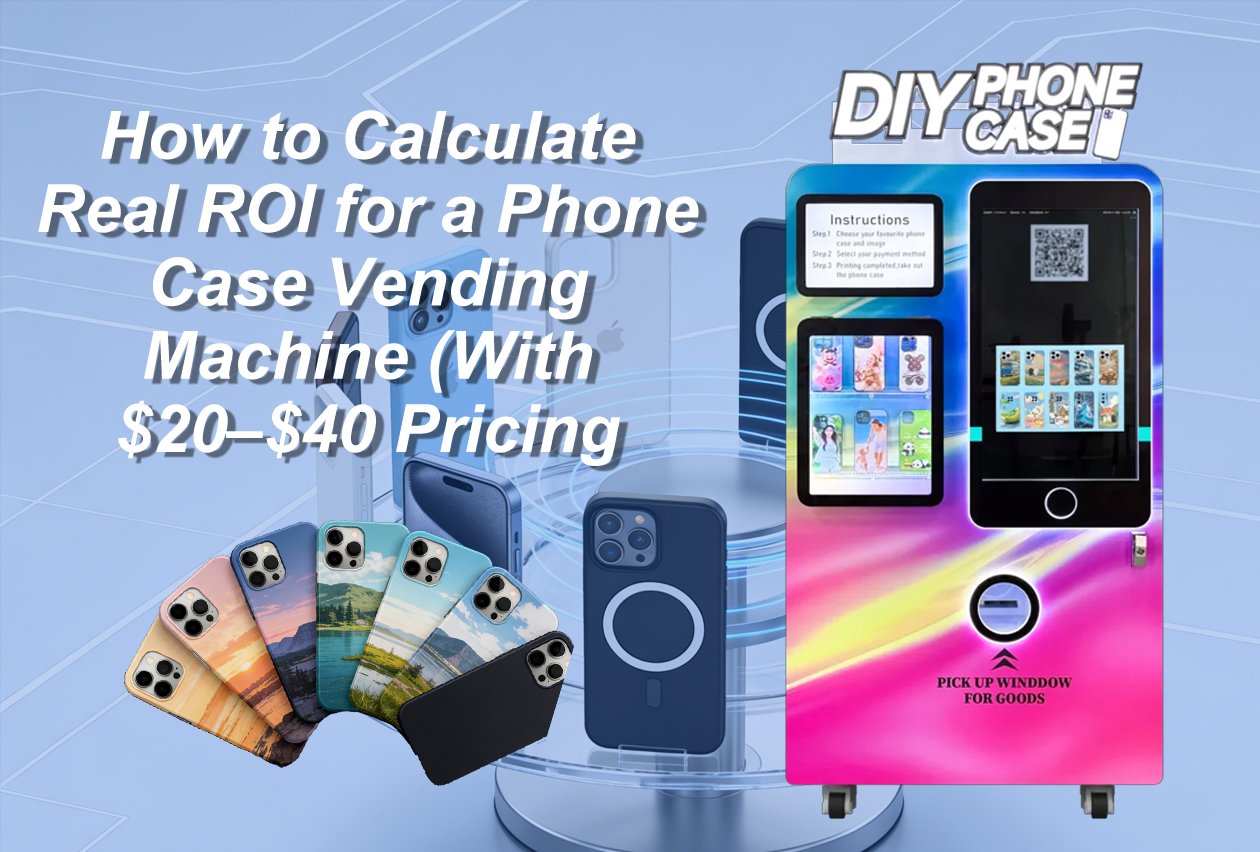
When people ask,
“Is a phone case vending machine profitable?”
The better question is:
How long does it take to recover your investment — and what determines that speed?
Many online discussions throw around rough numbers.
Very few explain the actual mechanics behind return on investment (ROI).
Today, we’re going to break it down step by step — using a realistic pricing range of $20–$40 per customized phone case, which is increasingly common in malls, airports, and tourist locations.
This isn’t hype.
It’s math.
1. Understanding the Core Variables
ROI depends on five main factors:
- Machine cost
- Selling price per case
- Cost per case (materials + ink)
- Daily sales volume
- Fixed operational costs (rent, commission, electricity, servicing)
Let’s walk through each one realistically.
2. Initial Investment: What Are You Really Paying For?
A quality phone case vending machine with advanced printing system typically ranges from:
$6,000 – $12,000, depending on features, printing structure, and software system.
For our calculation model, let’s assume:
- Machine purchase price: $8,500
- Shipping & setup: $1,000
- Initial inventory: $500
Total initial investment: $10,000
This is a realistic mid-range setup for a serious operator.
3. Selling Price Strategy: Why $20–$40 Works
Earlier we discussed location-based pricing:
- Shopping mall: $20–$30
- Airport: $30–$40
- Tourist attraction: $25–$35
Let’s assume a conservative blended average selling price of:
$28 per case
This is neither aggressive nor overly optimistic.
4. Cost Per Case: The True Variable Cost
Typical production cost per customized phone case includes:
- Blank phone case: $2.50 – $4
- Ink & coating: $0.80 – $1.20
- Wear & consumables allocation: $0.50 – $1
Average total cost per unit:
~$5 per case
That means:
Selling price: $28
Cost: $5
Gross profit per case: $23
That’s an 82% gross margin.
This is why customized products outperform traditional retail.
5. Daily Sales Scenarios (Conservative vs Moderate vs Strong)
Let’s model three realistic performance scenarios.
Scenario A: Conservative Location
- 6 sales per day
- $28 average price
- $23 gross profit per unit
Daily gross profit:
6 × $23 = $138 per day
Monthly (30 days):
$138 × 30 = $4,140
Scenario B: Moderate Location
- 10 sales per day
10 × $23 = $230 per day
Monthly:
$6,900
Scenario C: Strong High-Traffic Location
- 15 sales per day
15 × $23 = $345 per day
Monthly:
$10,350
6. Subtracting Fixed Costs
Now let’s factor in operational costs.
Common expenses include:
- Location commission (10%–25%)
- Electricity
- Internet connection
- Occasional servicing
Let’s assume:
- 20% location commission
- $200 monthly utilities + misc
For Scenario B (10 sales/day):
Monthly revenue:
10 × $28 × 30 = $8,400
20% commission:
$1,680
Remaining:
$6,720
Minus $200 utilities:
$6,520
Minus material cost (10 × $5 × 30 = $1,500)
Net monthly profit:
$6,520 – $1,500 = $5,020
7. Realistic Payback Period
Initial investment: $10,000
Monthly net profit (moderate scenario): ~$5,000
Estimated payback period:
Approximately 2–3 months
Even under conservative conditions (6 sales/day), payback typically falls within:
3–5 months
Strong locations may recover investment in under 2 months.
That’s unusually fast compared to many retail businesses.
8. What Slows ROI Down?
There are common mistakes that extend payback time:
- Poor location selection
- Underpricing (below $20)
- Weak design interface
- High mechanical downtime
- Poor visibility placement
Many operators lose margin not because the business model fails —
but because execution lacks strategy.
9. Why Premium Pricing Accelerates ROI
Some beginners fear pricing at $30–$40.
But here’s the reality:
In environments like malls and airports, customers compare value, not cost.
A custom phone case offers:
- Personalization
- Instant production
- Emotional value
- Convenience
When positioned correctly, higher pricing:
- Increases per-unit profit
- Requires fewer daily sales to break even
- Improves long-term sustainability
Selling 8 units at $35 can outperform 15 units at $18.
Volume alone doesn’t define success.
Margin does.
10. Scaling Beyond One Machine
Once the first machine recovers its cost, expansion becomes strategic.
Example:
If one machine nets $5,000/month,
three machines can generate $15,000/month (assuming similar performance).
At scale:
- Shared logistics reduce cost
- Maintenance becomes more predictable
- Inventory purchasing improves margins
Automated retail thrives on replication.
11. Risk Management Perspective
Unlike traditional retail stores, vending machines offer:
- No full-time staffing cost
- Minimal overhead
- Flexible relocation
- 24/7 operation
This lowers business risk significantly.
Even if sales drop temporarily, fixed cost exposure remains limited.
This is why many entrepreneurs choose automated retail as a semi-passive income model.
Conclusion: ROI Is Math — But Strategy Determines Speed
A phone case vending machine priced between $20–$40 per unit offers:
- High gross margin
- Low labor cost
- Fast payback potential
- Strong scalability
Under moderate conditions, a 2–4 month recovery period is realistic.
But success depends on:
- Location quality
- Pricing discipline
- Machine reliability
- Operational oversight
The business model works.
Execution determines outcome.